
I roasted four whole pork loins in three days leading up to December. My kitchen smelled like an alpine lodge where rosemary and roasting apples met sizzling butter, but my first test roast was an absolute disaster. I followed an old family recipe, cooked the meat to 165 degrees, and produced a roast so dry and chalky that my dinner guests needed two full glasses of water just to swallow a single bite. I was on a mission to eliminate the single most widespread cooking tragedy in holiday dinner history: the gray, sawdust pork roast.
Let me be brutally honest with you. Most pork roast recipes on food blogs are an exercise in culinary cruelty. They tell you to buy a lean boneless loin, slather it in sweet honey glaze on minute one, shove it in a hot oven, and bake it until there is zero pink left inside.
What happens? The sugar in the glaze burns to bitter black soot before the center is even warm. Worst of all, overcooking lean pork muscle past 150 degrees forces every microscopic drop of natural juice out into the pan, leaving you with meat that chews like damp cardboard.
We are not doing that today.
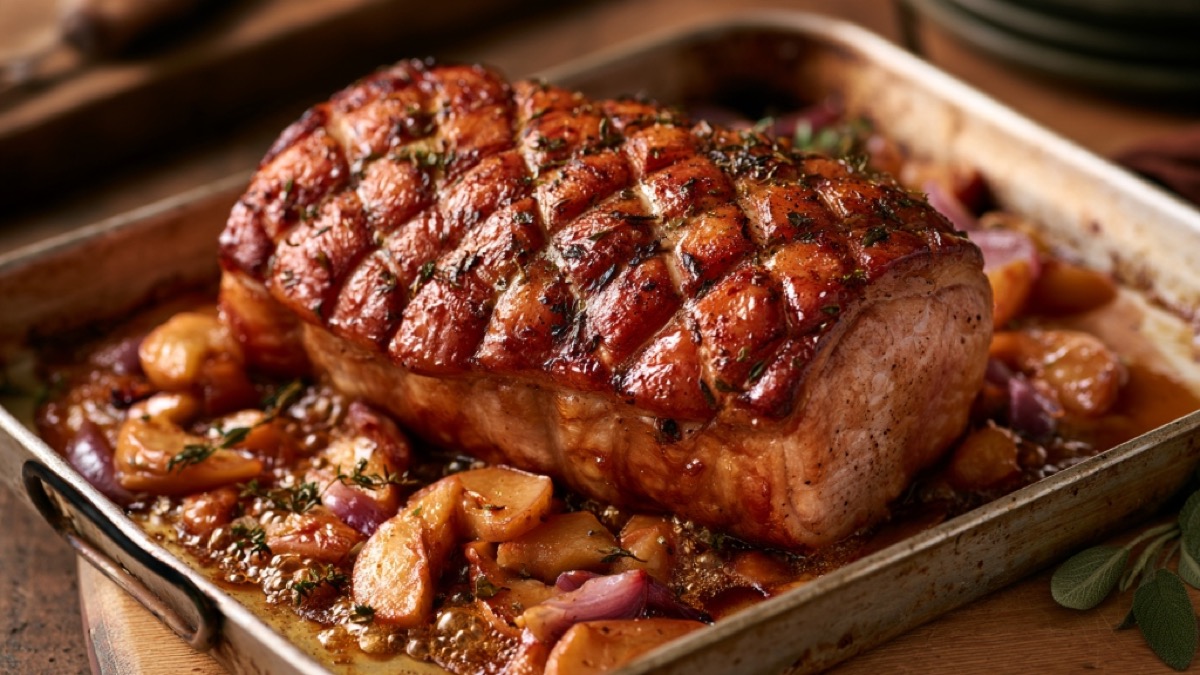
Today we are making the ultimate Garlic Herb Christmas Pork Roast. We are talking about thick, juicy center-cut pork loin crowned with an intensely aromatic crust of rosemary, thyme, sage, and garlic. We roast it over a bed of sweet Honeycrisp apples and red onions, baste it with a bubbling apple cider maple glaze, and pull it at the exact temperature threshold that guarantees mouthwatering succulence in every forkful. Pair it with a steaming mug of slow cooker mulled wine or a bowl of loaded baked potato soup, set this carved masterpiece in the center of your Christmas table, and your guests will forget all about prime rib.
The Food Science of The 145-Degree Threshold
To cook a pork roast that people rave about for years, you have to understand the protein structure of pork loin.
Pork loin is an extremely lean cut of meat with very little intramuscular marbling. For decades, home cooks were terrified by outdated 1970s government warnings about trichinosis, leading generations of families to incinerate pork until it hit 165 or 170 degrees Fahrenheit. The USDA officially updated that guideline over a decade ago: clean, commercially farmed pork is 100 percent safe at 145 degrees Fahrenheit with a three-minute rest.
Here is what happens inside the meat as the temperature climbs:
- The 130 to 140 Range: Myosin proteins denature and firm up, but the intracellular liquid remains trapped inside the muscle fibers. The meat is tender, succulent, and delicate.
- The 150-Degree Danger Zone: Actin proteins violently contract like tightening rubber bands. They squeeze the muscle fibers dry, expelling up to 30 percent of the meat’s moisture out into the pan.
- The 165-Degree Death Sentence: The cellular moisture is gone. The muscle fibers shrink into tight, dense ropes, resulting in that dreaded chalky chew.
We solve this with absolute precision. We pull the roast from the oven when an instant-read digital thermometer reads between 140 and 142 degrees Fahrenheit. As the roast rests under a loose tent of foil on your cutting board, carryover thermal momentum pushes the internal temperature right to 145 degrees. The muscle fibers relax, reabsorbing their natural juices, leaving you with tender meat and a gorgeous faint blush of pink.
The Four Non-Negotiable Secrets to Holiday Pork Perfection
Follow these four rules and your Christmas centerpiece will be flawless on the very first try.
1. Score the Fat Cap in Diamonds. Boneless pork loin usually comes with a quarter-inch layer of white fat running along the top. Do not trim this off! Use a sharp chef knife to slice shallow diagonal lines across the fat in both directions, creating a diamond pattern. Scoring allows the heat to penetrate and render the fat, turning it golden and crisp while creating channels that hold our herb paste in place.
2. The Two-Temperature Roast. Never cook a roast at a single flat temperature. We start the pork in a screaming-hot 425-degree oven for the first 15 minutes. This high-heat blast sears the exterior meat, blisters the scored fat cap, and triggers the Maillard reaction. We then drop the oven down to 325 degrees for the remainder of the cook, allowing the interior to coast gently to 140 degrees without overcooking the outer meat.
3. Never Glaze Raw Meat. If you brush a sugary maple cider glaze onto cold, raw pork, the sugars will caramelize and burn to bitter carbon long before the pork cooks through. We season the pork initially with an herb, garlic, and olive oil paste that can take high heat. We only brush the sweet apple cider glaze over the roast during the final 15 minutes of cooking, creating a glossy, sticky mahogany finish.
4. The 15-Minute Cutting Board Rest. If you slice into this roast the second it comes out of the oven, hot juices will flood across your cutting board, leaving the meat dry. Let the roast sit undisturbed under loose foil for 15 minutes. This allows the internal pressure to normalize and the juices to redistribute evenly throughout the entire cut of meat.
Flavor Twists and Seasonal Swaps
This herb and cider combination is an autumn and winter masterpiece, but you can easily tailor it to your holiday table.
Cranberry Orange Bourbon Glaze: Swap half of the apple cider for tart unsweetened cranberry juice and add a splash of bourbon with freshly grated orange zest. The bright ruby-red glaze brings a festive color and an electric tartness that balances rich pork fat.
Bone-In Center-Cut Rib Roast: If you want a dramatic presentation that looks like a crown roast, buy a bone-in pork rib roast (often called a pork rack). The bones insulate the meat, making it even juicier. Follow the exact same seasoning and temperature rules, adding roughly 10 to 15 minutes to the low-temperature roasting time.
Bacon-Wrapped Holiday Loin: For an extra layer of decadence, wrap the seasoned pork loin in a lattice weave of thin-cut bacon before roasting. The bacon renders into the meat, basting the loin continuously as it cooks.
Bennett’s Troubleshooting Guide
Did something look off during your cook? Here is how to diagnose and fix it in real time.
Why is my roast taking longer than the recipe says? Cooking times vary based on the thickness of your pork loin and how cold the meat was when it entered the oven. If your roast was straight out of the fridge, the center will take an extra 15 minutes to heat through. Always rely on a digital probe thermometer inserted into the center rather than clock time.
What if the bottom of my roasting pan looks dry? If the apple and onion bed looks like it is starting to scorch, splash a quarter cup of water, broth, or cider into the bottom of the pan. You want those drippings to caramelize gently, not turn into bitter black smoke.
Can I prep this the day before? Yes, and it actually tastes even better. Rub the pork loin with the herb garlic paste on Christmas Eve, place it in the roasting pan with the scored fat cap up, and leave it uncovered in your refrigerator overnight. The salt will dry-brine into the meat, and the circulating air will dry the fat cap, resulting in an even crispier roast on Christmas Day.
Storage and The Next-Day Cuban Sandwich Hack
Leftover pork roast is one of the greatest gifts of the holiday season, provided you do not microwave it into rubber.
Refrigerator Storage: Wrap leftover roast tightly in plastic wrap or store in an airtight container with any leftover pan juices in the fridge for up to four days.
The Next-Day Holiday Cuban Sandwich: Slice leftover cold pork loin into thin strips. Butter a crusty baguette or Cuban bread roll, spread with yellow mustard, and layer the pork with sliced holiday ham, Swiss cheese, and dill pickle chips. Press the sandwich in a hot panini press or a heavy skillet weighted down with a cast-iron pan until the bread is golden and the cheese is molten. It might honestly be better than Christmas dinner itself.